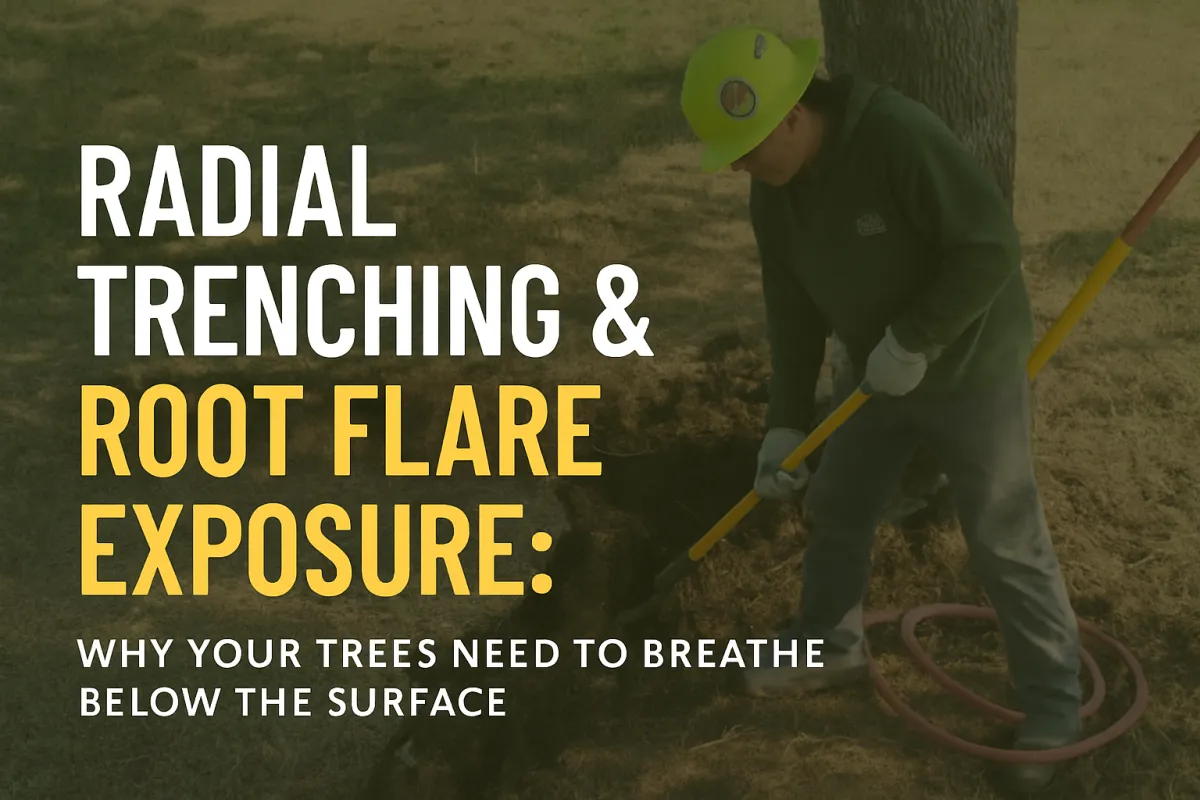
Radial Trenching & Root Flare Exposure
Radial Trenching & Root Flare Exposure: How We Restore Tree Roots in San Antonio
When most people think about tree care, the focus tends to stay above ground—pruning branches, removing hazards, treating pests, or assessing canopy health. But some of the most important parts of a tree’s wellbeing lie quietly underground.
Two highly effective, yet often overlooked, techniques for improving long-term tree health are radial trenching and exposing the root flare (also called root collar excavation). These methods help restore proper root function, improve soil conditions, and correct issues that could compromise your tree’s stability, health, and lifespan—especially in our compacted, rocky San Antonio soils.
Here’s why they matter, and how they work.
What Is the Root Flare (and Why Should You See It)?
The root flare is the area at the base of the tree where the trunk widens and transitions into the roots. On a healthy tree, this flare should always be visible above the soil line.
Unfortunately, many trees in neighborhoods around San Antonio become buried under excess soil, landscape fill, or deep mulch—especially when “mulch volcanoes” are created around the trunk.
When the root flare is buried, the tree can suffer from:
Reduced oxygen to the roots
Excess moisture and rot at the base of the trunk
Girdling roots that wrap around the trunk and choke growth
Structural instability
Increased vulnerability to pests, disease, and decline
Exposing the root flare allows the tree to function as it was designed, improving both its health and resilience.

After root flare exposure, you can clearly see the natural flare at the base of the trunk
Our ISA Certified Arborists carefully remove excess soil and mulch around the trunk so the root flare is visible again, without damaging the tree. This one step alone can make a dramatic difference in a tree’s long-term health.
What Is Radial Trenching?
While root flare exposure focuses on the base of the trunk, radial trenching focuses on the root zone around the tree.
Radial trenching is a technique used to rejuvenate compacted, oxygen-poor soil around a tree’s root zone. Using specialized air tools—most commonly an AirSpade or similar device—arborists create narrow trenches that extend outward from the trunk like the spokes of a wheel.

One of our ISA Certified Arborists using an AirSpade to gently loosen soil without damaging roots
These trenches are then backfilled with high-quality organic material such as compost, biochar blends, or nutrient-rich soil amendments.
Radial trenching and root flare exposure around this oak loosens compacted San Antonio soil so roots can breathe and absorb water again

What Radial Trenching Does
Radial trenching helps:
Loosen heavily compacted soil
Increase oxygen flow to the roots
Encourage new feeder root growth
Improve water absorption and nutrient uptake
Trees growing near driveways, patios, new construction, or high-traffic lawn areas in the greater San Antonio area benefit tremendously from this technique.
Together, radial trenching and root flare exposure help trees develop healthier root systems, stand more securely, and better handle Central Texas heat, drought, and storms.
When Should You Consider Root Flare Exposure or Radial Trenching?
These treatments are best performed by an ISA Certified Arborist, especially when dealing with mature or high-value trees like live oaks and red oaks.
You might consider a root flare assessment or radial trenching if you notice:
Soil or landscape rock mounded against the trunk
Excessive mulch buildup (“mulch volcanoes”)
Small, declining, or sparse leaf growth
Surface roots circling the trunk (girdling roots)
Heavy foot traffic or visible soil compaction near the tree
Trees planted too deeply or on top of fill dirt
Recent construction, trenching, or grading within the root zone
Correcting these issues early can prevent long-term damage and greatly extend the life of your tree.
If you’re seeing any of these signs on your property, Mission City Arbor Group’s ISA Certified Arborists can assess your tree and recommend the right combination of root flare exposure, radial trenching, and soil improvement to help it recover. Call us today to schedule a Root Zone Health Assessment for your trees in the greater San Antonio area.
📞 Call us today at (210) 934-6339 to schedule a Root Zone Health Assessment for your trees in San Antonio.
🌳 Mission City Arbor Group — Where healthy roots create safer, healthier trees for your home.
FAQs About Radial Trenching & Root Flare Exposure
1. Will radial trenching damage my lawn or irrigation system?
Radial trenching is done with an AirSpade, which uses compressed air to gently move soil without cutting through roots the way a shovel would. In most cases, any disturbance to the turf is temporary and will recover as the soil is improved. Before we begin, our arborists will ask about irrigation lines, utilities, and any other underground features so we can work carefully around them.
2. How long does it take to see results after radial trenching or root flare exposure?
Every tree is different, but many homeowners in the San Antonio area start to notice improvements within one growing season—such as fuller foliage, better color, and less early leaf drop. The real benefit is long-term: healthier roots, improved stability, and a tree that is better able to handle heat, drought, and storms.
3. Can’t I just add fertilizer instead of doing root flare exposure or radial trenching?
Fertilizer can help in some situations, but it doesn’t fix buried root flares or compacted soil. If a tree is planted too deep, smothered in mulch, or struggling in hard, compacted ground, the roots simply can’t breathe or function properly—no matter how much fertilizer you apply. Root flare exposure and radial trenching address the underlying problems so any future treatments (including fertilizer) are more effective.
4. Is this service only for large or “high-value” trees?
Not at all. While we often perform root zone restoration on mature oaks and other large shade trees, younger trees can benefit as well—especially if they were planted too deep or have experienced recent construction stress. Investing in proper root care early can prevent costly removals and replacements later.


